







Ten structural, behavioural, and environmental factors that quietly shape how much value SME teams actually produce each day.
Key Takeaways:
- What are the biggest factors affecting SME productivity? Clarity of expectations, communication flow, manager effectiveness, workload balance, and process design. Most productivity problems are structural, not motivational.
- Why does unclear priority-setting cost so much? When employees can’t tell what matters most, they either stall waiting for direction or guess wrong. Both waste time and erode confidence.
- What is the workload paradox? Teams working at full capacity lose the ability to absorb surprises, think creatively, or self-correct. The most productive teams typically run below 100% utilisation.
- Why doesn’t adding more tools fix productivity? A tool that doesn’t integrate with existing workflows creates more overhead than it removes. Audit for duplicates before buying anything new.
- How can SME leaders build a system that supports productivity? Make priorities and progress visible, create low-friction ways for teams to share updates, and build feedback loops so the system improves over time.
Employee productivity is how efficiently and effectively individuals or teams use their time, energy, and resources to generate value that contributes to a successful business. In small and medium-sized enterprises (SMEs), productivity doesn’t appear suddenly; it is highly influenced by certain factors that affect productivity in the workplace. These factors often show in subtle ways, such as sending a timely invoice without reminders, completing a project a day early because the team was proactive, or a new employee becoming productive sooner than expected because someone took the time to document the process.
As an SME leader, it’s more useful for you to understand the factors that affect productivity rather than relying on motivational posters on your office wall. The main factors affecting employee productivity are usually straightforward: they are “structural, behavioral, and environmental.” Figuring out which of these factors will have the biggest impact on your company and where small improvements can lead to significant gains can be challenging.
Just like productivity, production challenges often arise quietly and without much notice. These issues usually show up as missed handoffs, repeated questions, or awkward silences during meetings, when everyone is waiting for someone to remember what happened a week ago. While many may not realize it, these are common frustrations for many people and can sometimes be early warning signs of larger problems that reduce team productivity in small or medium-sized companies.
What Does Your Employees’ Productivity Look Like?
Productivity is most often measured by dividing outputs by inputs; however, many people find this formula more confusing than clarifying. In knowledge work, there may not be an hourly rate of production, as previously mentioned (i.e., products produced per hour). It may be one conversation that prevents the team from spending three weeks doing the wrong thing. It may also be an employee noticing a problem in an earlier phase, thereby enabling it to be resolved at a lower cost.
SME leadership teams should define productivity as the speed at which time spent on an effort is converted into an outcome for your company’s business. This would include visible work products (planning documents, scopes of work, etc.), business outputs (signature pages), business services (sales, shipped features), and data associated with the business output but not part of a specific business output (corporate decisions, team problems, and the context of where they fit in the future).
Why Productivity Deserves Serious Attention
Before looking at the specific factors, here is what is at stake when productivity slips:
- Cash Flow Stability – Employees are often your most considerable expense, and productivity directly affects how much return that expense generates.
- Competitive Advantage – For SMEs, the biggest disadvantage is that they cannot afford to outspend larger competitors, but they can generally move faster and more nimbly, which gives them a competitive edge.
- Employee Engagement – When employees feel that they have clarity regarding their roles and accountabilities, they will be less likely to leave; however, when employees do not know what is expected from them, they will most likely leave for another organization.
- Leadership Capacity – Whenever you experience low productivity in an organization, this limits the ability of leaders because more time will need to be spent putting out “fires.”
- Customer Satisfaction – Customers will notice when you’re running smoothly, and customers will definitely notice when you’re not.
Ten Factors That Affect Productivity in SMEs
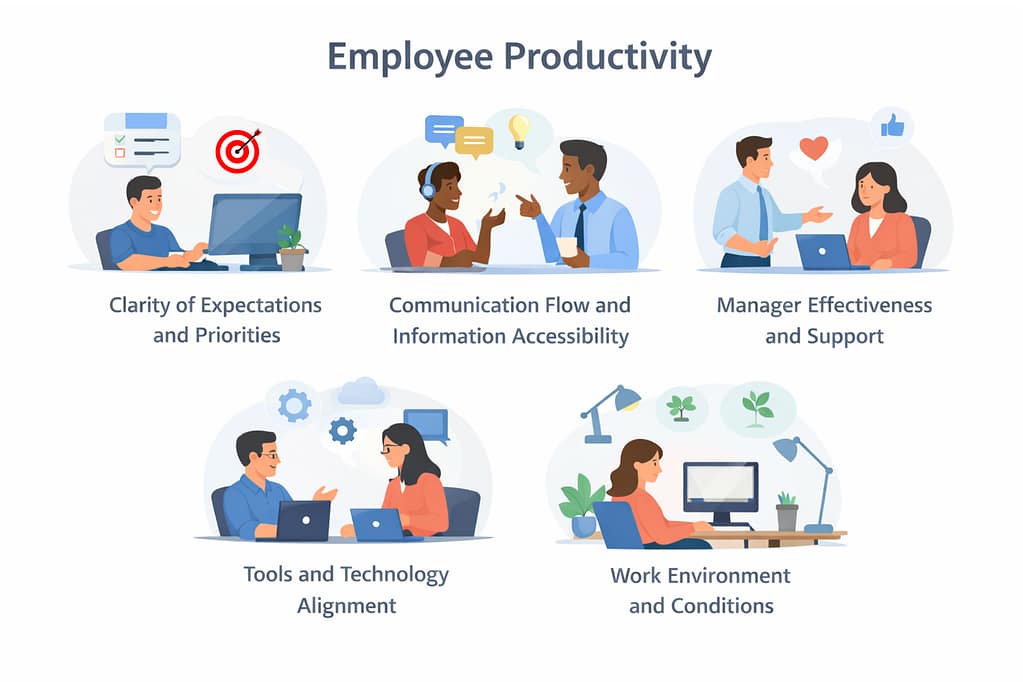
1. Clarity of Expectations and Priorities
The cost of uncertainty is high; employees require clear guidance on which tasks they should be performing in order to make progress. If an individual is unclear as to which items are a priority, this can lead to either stagnation while an employee attempts to get clarification from a manager or an employee attempting to infer what is of a higher priority based on best guesses. When this happens, team members may set their own priorities independently, leading to misaligned efforts and wasted work. An example of this might occur when team members work all day (Friday) on projects to realize that the direction they were pursuing did not meet the final requirement on Monday.
Clarity of expectations leads to increased productivity due to quicker starts, the ability to independently and confidently make decisions, and less time seeking approval. When expectations are clear, it removes ambiguity for who is responsible for performing which activities and the standard to use when handing off activities between participants.
Clearly communicate priorities (in writing) because priorities will change throughout the work week. As projects are delegated, communicate success criteria (i.e., what the outcome will look like) along with the work assigned to complete the outcome. Create a regular (weekly, monthly, or otherwise determined) meeting(s) in which priorities will be communicated consistent with the pace of the project.
2. Information Access and the Flow of Communication
Poor information architecture can be a significant, but often unnoticeable, drain on time. When work updates are being communicated through multiple channels (such as Slack, email, and “foggy” memories), the effort required to find the context of prior conversations will be extensive, and as a result, some people will have to decide to make a choice without having context or information. All of this adds up to an overwhelming sense of fatigue as people jump between platforms trying to piece together what they need.
Better communication means making decisions quicker, therefore increasing productivity because relevant information is accessible and can be used while making a decision. New employees will be able to acclimate to the company more quickly. Managers can gain insight into the progress of their team members without having to arrange meetings just to have an update on where things stand.
Create rules regarding where types of information must be stored; try to limit the number of places staff need to look for that information, ensure work status updates occur on a schedule that provides predictability, and ease into it. Implement solutions that allow you to aggregate updates from multiple sources into one easily accessible and searchable location. Recently, lightweight, informal methods of providing work updates have been adopted by task teams. The use of audio notes that are automatically transcribed and organized allows for less time spent providing updates, but still gives useful documentation. Project and customer-based dashboards highlight trends so managers do not have to spend time chasing after information.
3. Managers Effectiveness and Support
Managers working in SMEs often have hybrid responsibilities because they are required to manage others’ work as well as perform their own tasks as contributors to work. The hybrid role creates tension, especially when managers are overwhelmed with work or are unable to provide direction and support to their teams adequately; therefore, productivity will decline in ways that will be difficult for upper management to determine the cause. For example, when an overwhelmed manager cannot provide clear direction, the confusion cascades down, and employees become uncertain about their responsibilities, and errors go unaddressed.
There is a clear correlation between effective management and productivity through the removal of blocks to productivity and providing timely feedback so that the employees will have an opportunity to change or correct their performance before it becomes a significant concern. Also, employees will develop additional skills (and not become stagnant) because they have received guidance from their manager and have good morale. As a result, the employees will bring more effort to work than just completing the minimal effort required to complete the work.
Managers need training on the functions that matter most: giving feedback, running effective one-on-ones, and spotting early signs of burnout or confusion. They also need systems that let them see what their teams are working on without having to micromanage.
4. Tools and Technology Alignment
Tools and productivity are often seen as directly related, with the idea that more tools lead to higher productivity. However, this isn’t always true; in some cases, adding more tools can even hinder progress. The key factor is whether these tools reduce friction in shared workflows. For example, I once worked with a company that purchased seven different project management tools in three years. No one could find what they needed, and searching for the right tool became a waste of time for everyone.
When tools and technology are properly aligned, a team’s productivity increases because repetitive tasks can be completed more quickly. Additionally, handoffs become smoother since information can be transferred from one system to another without manual entry. As a result, employees use less mental energy when switching between tools.
You should audit your tools to eliminate duplicate and missing tools. Focus on the integration of a tool with your current infrastructure; a tool that integrates with your current infrastructure is always worth more value than one that does not. Before purchasing any new software, you should confirm that it will solve a problem rather than adding more processes for managing.
5. Work Environment and Conditions
The term “environment” includes both the physical setting (home, office, or hybrid) and the intangible factors, such as noise, distractions, and the sense of safety needed to focus fully. Common distractions in an office, like the hum of air conditioning, sunlight streaming through the windows in the afternoon, and the scent of coffee from three desks away, all affect how we work, but do not have much effect on productivity systems.
We need to employ our full attention while we do knowledge work. Frequent, unexpected interruptions disrupt everyone’s thought processes, causing delays in progress. The American Psychological Association has researched the effect interruptions have on productivity and concluded that even minimal interruptions can greatly increase the amount of time required to return to “normal.” In addition, it’s important to consider that poor working conditions (hot or cold, too much or too little light, uncomfortable workstations) create a continuous drag on our ability to concentrate as we work.
When designing office space, it is critical to have defined areas for different types of work: quiet spaces for focused work, collaborative spaces for teamwork, etc. Since remote workers may not have access to the appropriate office furniture, their home office environments should be supported to enhance their productivity. Develop team guidelines on how to handle interruptions while working on projects. Not all questions or requests for assistance require an immediate response.
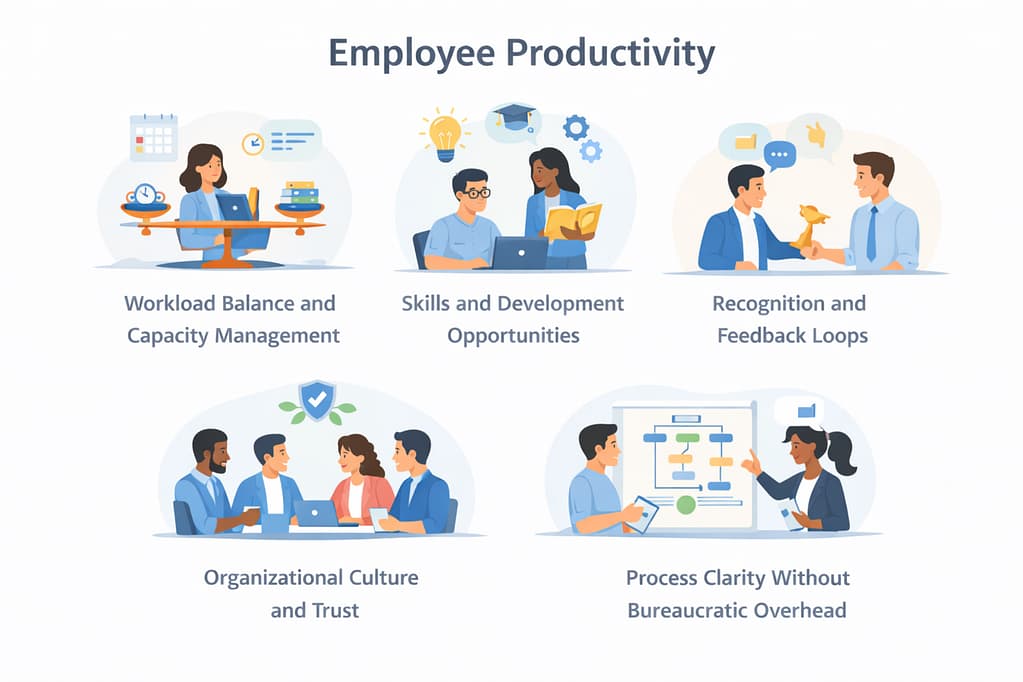
6. Workload Balance and Capacity Management
The amount of work employees do has a much bigger effect on their productivity than many leaders realize. The number of hours worked does not directly correlate with the quality of work produced. At some point, working more hours per week results in progressively reducing, and eventually negative, returns on investment.
Additionally, fatigued workers will make more errors and take longer to complete their work. A certain “grayness” appears within a team that has been under continuous stress and pressure for too long; for example, the usual creativity and idea exchange that occur in meetings will be absent. Balancing the workload will increase productivity by giving teams the opportunity to work at a sustainable pace and produce a higher-quality product. This allows employees to retain their good judgment. Turnover will be reduced, thereby increasing institutional knowledge.
Make sure to monitor the actual utilization of capacity compared to the assigned workload; leave some buffer or slack in the schedule, versus trying to achieve 100% utilization. Look for any warning signs such as: recurring overtime, abandonment of personal commitments, or lack of engagement in discretionary activities.
7. Skills and Development Opportunities
Productivity is also reliant on capability. This is common sense, but it can frequently be overlooked due to the busyness of everyday work. If a team member does not possess the skills to successfully perform their job function, then a lack of motivation will prevent them from gaining those skills. As individuals are successfully developing, they engage more fully and become better able to do their work.
Development will result in more productivity through less need for task assistance and fewer task revisions. Employees will have the ability to work on projects of greater complexity. Employee mobility within the organization contributes to reducing hiring costs.
Skills gaps can be identified throughout the year instead of waiting for a yearly performance review. There are many opportunities for assigning employees to “stretch” assignments that aid in skill development. Training programs should be targeted to employees based on actual needs vs. generic training related to job functions, so as to make the training worthwhile.
8. Recognition and Feedback Loops
Employees deserve feedback on the value of their contributions and on whether they are working properly. Employees who do not receive regular feedback will have to work from an information void. They can hold on to ineffective ways of doing things or allow their drive and motivation to try new ideas to subside. The long-term impact of this is damaging and, at the same time, less obvious until it reaches critical mass.
When employees receive timely recognition for their contributions to team efforts, they will be more productive because they will learn more quickly how well they are performing. Their collective morale is elevated by the ongoing acknowledgment of their contributions to the team’s efforts. Teams develop a shared understanding of the quality standards the team will use.
Recognition of individuals or teams must be specific and timely, rather than general and delayed. Timely feedback must be integrated into ongoing work processes, rather than treated as a separate process. Celebrating successes must be done in a way that ensures all team members have a clear understanding of what success looks like.
When value is placed on evidence by the successful completion of a project, recognition is more precise. When leaders can see what was occurring during each step of the process, including all the effort that went into the completion of the project that happened behind the scenes, leaders are more inclined to provide recognition than when they are unable to see what occurred. Systems that provide an automatic view of work progress and success can assist in closing the gap between recognition and evidence of effort and results.
9. Organizational Culture and Trust
Culture is the learned behaviors, the way work actually gets done, not the aspirational statements on a company’s website, etc. During times of low trust, people expend their energy and time protecting themselves. They create defensive documentation, they avoid accountability, and they withhold information that could negatively reflect on the person withholding it. All of this friction slows down productive work. When you enter the office of an organization with low trust, there is an air about it, as if every person in the office is restrained in how they carry themselves throughout the course of the day.
When trust exists, information flows freely and issues get resolved quickly. Collaboration happens naturally, without requiring heavy coordination between teams.
Modeling the behaviors and actions you want to see is important. When mistakes happen, use them as opportunities for learning and not to assign blame. Default to transparency when sharing information, and give people the opportunity to voice their concerns without risking their jobs.
10. Process Clarity Without Bureaucratic Overhead
Processes generally enable outcomes to be repeated over time or by different people and help document knowledge. However, they can sometimes create barriers by requiring so many approvals and documents that the process itself gets buried under its own overhead.
Good process design allows people to do their work in a productive manner, rather than having to rely on someone else’s completion (handoff) of their work. It also enables new employees to reach their maximum productivity in a shorter time frame. Once context is retained in the system, leaders can confidently delegate work to others.
Organizations should document processes that are either high-risk or high-volume in a way that encourages people to review them. Organizations should consistently review their processes to eliminate those that no longer serve a purpose. The goal of separating “What are we attempting to achieve” from “How do we perform this specific task” must be considered.
Culture’s Role in Productivity
Culture is an important factor that influences productivity. While a strong culture may not ensure high productivity, a weak culture can significantly hinder it. The culture of SMEs is even more fluid; it’s influenced by a smaller number of people, including the habits of the founders, the norms established by the first employees, and reactions to key events. This flexibility can be helpful, as culture can be intentionally shaped, but it can also become problematic if leaders do not pay attention and allow negative patterns to develop.
Cultural issues that impact productivity include hoarding information, not wanting to speak up about concerns, excessive politicking about credit and blame, and a recurring cycle in which decision-making is revisited due to a lack of trust in the decisions made. Cultural issues must be dealt with before levels of trust can be restored, so that tactical fixes can be effective at fixing the level of productivity.
The Workload Paradox
The workload paradox is that fully utilising people is typically counterproductive. If every minute of a person’s time is used, the chance is diminished for them to take care of the unanticipated, to think creatively, or to have that “off-the-cuff” conversation that produces exceptional ideas. The result is that people react to what is directly in front of them and do not allow themselves the time to determine whether those things are, in fact, the right things to be doing.
Typically, the most productive teams are working at less than full utilization. This is not a problem; this is an advantage because they can absorb variability, invest in improvement, and have the ability to maintain their judgment to produce quality work. Leaders who understand this principle do not try to fill every gap with additional work. It may appear to be inefficient on paper, but in practice, it is efficient.
Common Misconceptions About Productivity
The following are commonly held misconceptions regarding productivity:
- Studies conducted at Stanford regarding the number of hours worked indicate that, after 50 hours per week, more hours worked results in a negative impact (costs associated with errors and burnout are included).
- Productivity is directly related to individual effort; however, in the majority of knowledge work, the problem typically is not a lack of individual effort, but the result of coordinated effort, the ambiguity of hand-off points, a lack of context, and misalignment of priorities.
- Visibility is the same thing as micromanagement; however, this does not distinguish between leaders who need access to information versus leaders who need to micromanage via the use of information. Well-designed, high-quality visibility systems allow leaders to obtain information without having to check in continuously.
- Tools fix process problems; therefore, when a technology is introduced to a broken process, the result is a greater expense associated with the process.
Creating A System That Supports Productivity
The factors affecting productivity for SME teams are interconnected, and they need to be considered from a systemic (rather than piecemeal) perspective. Some of the most salient points regarding this issue include:
- Make visible what is important. When people can see the priority, progress, and issues, they can work together and self-correct. When this information is not visible (and is instead in people’s inboxes or their minds), it becomes a constant effort to stay coordinated.
- Make it easy for people to do what you are trying to achieve. If you want people to keep you updated, make it easy for them to do so. If you want people to collaborate, make it easy for them to share information with teams. People will always take the path of least resistance; design that path to lead toward something beneficial.
- Create feedback loops in systems that provide information about their performance, which can be made better over time. This applies to processes, teams, and individual employees.
- Maintain context over time and across people. When institutional knowledge lives solely in individuals’ minds, it is fragile. By documenting it, you will solidify that information.
BeSync’d has been built around many of these principles. It allows for voice or text recording of team members’ work updates, pulls in relevant activity from integration with tools like Slack, and organizes this information via dashboards and automated internal reports. It will also establish a searchable team knowledge base that allows questions to be answered through reference to specific entries, retaining context that would otherwise be lost. For the leaders of SMEs looking to get visibility without laying the administrative groundwork on their teams, such a system can simultaneously address multiple productivity problems, including clarity, communication flow, and manager effectiveness. All of these factors increase when work becomes visible and easy to track.
Moving Ahead
Productivity increases in SMEs do not typically result from massive fixes; rather, they develop slowly through focused attention to the contributing variables that define how work is completed. Start by identifying the key contributing factors in your situation that are creating roadblocks. Many times, fixing 1 or 2 of the underlying issues will create ripple effects across multiple symptoms.
Remember that your intention is not to squeeze the maximum productivity out of every moment. Your intention is to build an environment where capable employees can do their best work, where efforts reliably turn into results, and where the organization itself learns and improves over time. This type of productivity is sustainable and will attract and keep the workforce that makes it happen.